

The Generational Divide In How People Use AI
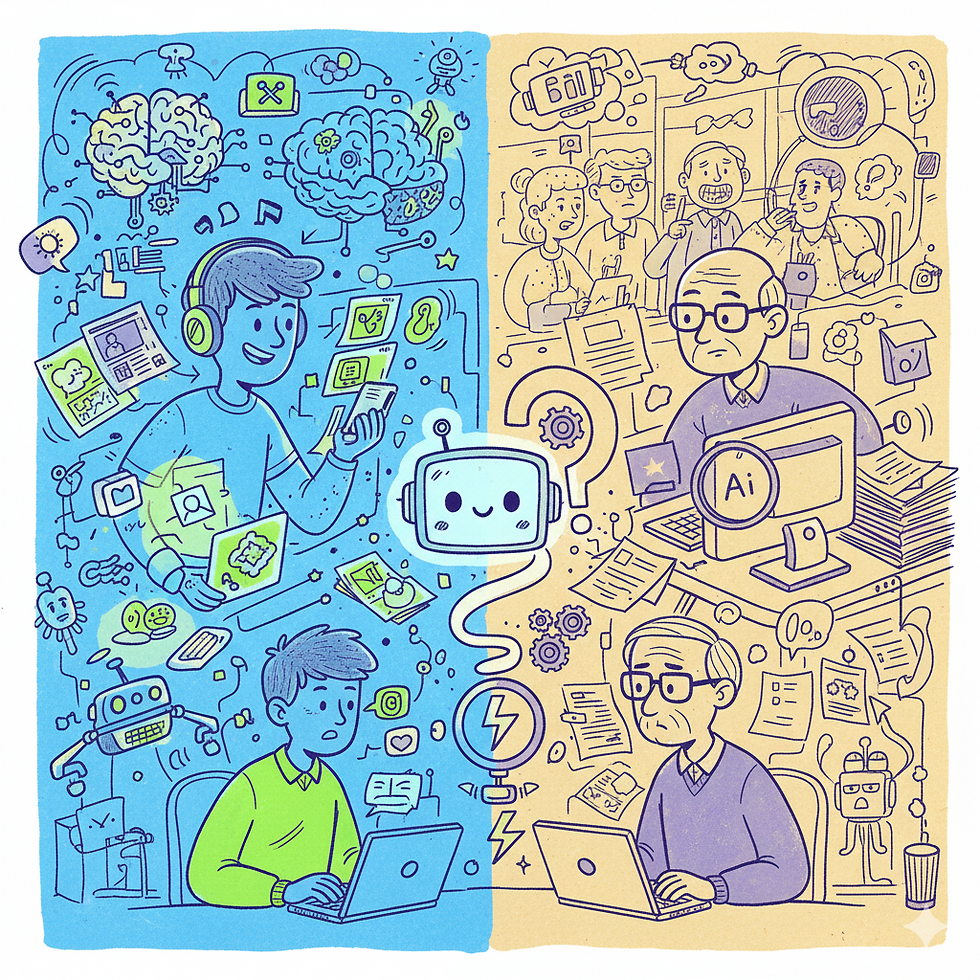
Gen Z views AI as a central operating system, as an extension of their thought process they integrate into everything. Millennials use it to maximize productivity at work while maintaining boundaries. Gen X approaches it cautiously when it saves time. Boomers prefer it invisible and simple. These might seem like minor preferences, but they’re pretty different relationships with the same technology, and they're colliding in actual workplaces right now.
93% of Gen Z use two or more AI tools weekly (TheySaid.io, 2026). Nearly two-thirds of younger employees actively help older colleagues learn AI (IWG Report, 2025). Meanwhile, 56% of Boomers don't use AI at all in their work (FM Magazine, 2025). Among leaders, over 91% of those aged 18-24 support extensive AI integration versus just around 23% of those over 65. (CensusWide, 2025).
It's not simply about digital natives versus digital immigrants. It's about different assumptions about what AI is for. Sam Altman noted that younger users treat AI as a life coach and memory system, sharing personal information and trusting its recommendations on major decisions. Older users treat it as an advanced search engine by asking questions, getting answers, and then moving on (Reddit/Altman, 2025). One builds relational trust. The other maintains transactional distance. Neither approach is right or wrong. They're just different enough to create friction.
The problem is that organizations are now caught between these two operating models. Leaders aged 18-24 expect extensive AI use. Leaders over 65 don't. Gen Z employees don't ask permission to use AI; they've already integrated it into their workflows. Older employees are being told to upskill on AI, but 64 percent of leaders expect employees to train themselves. That's the "self-teach paradox," where leaders are moving five times faster on adoption than on training implementation (CensusWide, 2025).
A phenomenon emerges from this gap that researchers are calling the "AI transparency paradox." Employees receive contradictory signals. Use AI to be productive, but don't let me notice you're using it (CensusWide, 2025). Gen Z responds by using AI openly. while older employees respond with suspicion or avoidance. Leaders don't solve this. They ignore it, creating a "don't ask, don't tell" culture where people either embrace or resist AI in silence.
The thing is that generational diversity actually improves productivity. Organizations with age-diverse teams show 77% productivity gains compared to 66% in homogeneous teams (FM Magazine, 2025). So the answer is obvious. Mix generations, have them teach each other, use both sets of wisdom. But it requires explicit design, intentional pairing, and leadership willing to slow down to go faster. Most organizations aren't doing this as of now.
Instead, what's happening is organizational sorting. Gen Z gravitates toward roles where they can use AI constantly (47% are involved in AI initiatives versus 30% of older employees) (FM Magazine, 2025). Older employees either resist or become support staff to the younger generation's AI-native workflows. The knowledge transfer that should happen, where younger workers learning strategic thinking from experience and older workers learning AI fluency from Gen Z, gets skipped in favor of siloed adoption.
As younger employees coach older colleagues on AI, the hierarchy flips. Seniority becomes less relevant when someone who joined two years ago understands the tools better than someone who's been here twenty years. That can create resentment that nobody talks about directly. It manifests as conflict over "the right way" to approach work, debates about pace and caution, arguments about whether certain tasks should be automated (Forbes, 2025).
It’s also interesting to note how different generations see AI's impact on careers. Seventy-four percent of Gen Z expect AI to change their work within a year and see it as an opportunity to learn and shift roles. Meanwhile, 56% of Gen Z and Millennials don't feel financially secure despite that optimism (Employer Branding, 2025). So younger workers are excited but anxious. Older workers are skeptical but pragmatic. Those emotional states colliding in the same meeting room creates a particular kind of workplace tension that training programs can't fix easily (Forbes, 2025).
There will always be questions such as whose approach to work is correct? Whose pace should dominate? Who gets to decide what gets automated and what stays human?
The generational divide in AI adoption is really a test of whether organizations can actually integrate different ways of thinking instead of just replacing one with another.


Comments