

How AI Helped Farmers
Updated: Dec 10, 2025
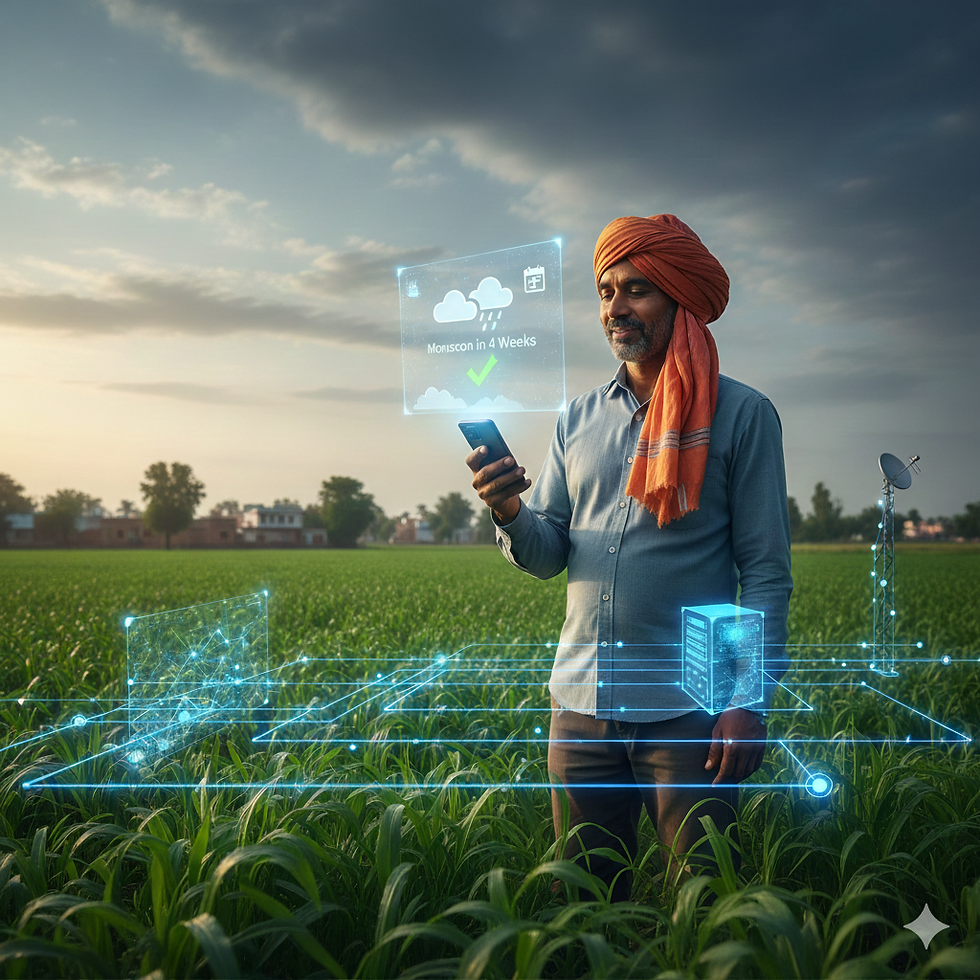
In India, 38 million farmers received a text message this summer with weather information that fundamentally altered what decisions they could make about their livelihoods. The message told them when the monsoon would arrive and they could plan four weeks in advance instead of being forced to guess (University of Chicago, 2025).
This might not sound that big until you understand what the alternative looks like. A farmer in South Asia has to decide what to plant and how much land to prepare without knowing whether the rain will arrive in two weeks or six weeks or not at all. Every decision is essentially a gamble on conditions they cannot control and cannot predict with any reliability.
The traditional approach to weather forecasting in developing countries has been constrained by physics-based models that require massive computational infrastructure and thousands of CPU hours per forecast. Most low and middle-income countries simply cannot afford to run their own forecasting systems and must rely on global models that are too coarse to be useful for individual farming regions (Conversation, 2025).
AI has now developed new weather forecasting models that operate thousands of times faster than physics-based systems while maintaining or exceeding their accuracy. A forecast that would have required a supercomputer can now be generated on a standard laptop in minutes.
Google's NeuralGCM and ECMWF's AIFS are two such models that India's Ministry of Agriculture and Farmers' Welfare integrated with local climate data to generate forecasts specifically for Indian farming regions. Then, they delivered those forecasts directly to farmers via SMS and voice messaging (University of Chicago, 2025).
The forecasts arrived four weeks in advance of the monsoon. That timeline significantly changes what a farmer can do because once the rain starts, it is too late to make major decisions like changing which crop to plant or expanding the land under cultivation or deciding to forgo farming entirely and seek work elsewhere.
A farmer who knows the monsoon will arrive in four weeks can make different choices than a farmer who is guessing, because the certainty creates possibility that uncertainty destroys.
The research showed that farmers who received accurate monsoon forecasts made better-informed decisions about what and how much to plant, which resulted in improved investment outcomes and diminished financial risk.
The best thing about this approach is that it combined several elements that had never been integrated at this scale before. It used AI models trained on global weather data then fine-tuned them with local climate information from India's Meteorological Department to correct for regional biases. Then, it delivered the forecasts through existing government SMS platforms to millions of farmers.
The efficiency gain is enormous because traditional physics-based models require solving fluid dynamics equations at every location and time step, which is intensive as well as expensive. AI models, on the other hand, learn weather patterns from data and can generate forecasts with a fraction of those resources.
One study showed that Google's FourCastNet AI model could be trained in approximately one hour on a supercomputer and then generate forecasts in minutes on standard hardware, making it thousands of times faster than comparable physics-based models (Conversation, 2025).
The broader context is that climate change is making weather more unpredictable and more extreme, which means the gap between farmers who have access to accurate forecasting and those who do not is widening.
Small farmers in developing regions are the most vulnerable to these weather shifts and the least equipped to manage uncertainty. Accurate forecasting has the potential to function as a tool for climate adaptation rather than just a convenience.
There are still challenges in scaling this approach, because delivering forecasts is different from making sure farmers understand them and can act on them. The project in India emphasized the importance of what they called co-designing messages with farmers to ensure that the forecasts were translated into language and framing that actually influenced farming decisions.
They discovered through testing that even the most accurate forecast could fall flat if it was not communicated clearly and in a way that aligned with what farmers actually needed to know.
The implications extend beyond just India because if this approach works in one of the world's most agriculturally dependent regions with hundreds of millions of farmers, it could be adapted to other parts of the world where food security is tenuous and where access to reliable forecasting is equally absent.
What we are seeing is the convergence of three things that were previously separate, which is computational efficiency breakthroughs in AI, the willingness of governments to invest in farmer-focused technology, and recognition that climate change has made traditional forecasting approaches inadequate for the decisions farmers now need to make.


Comments